


The description of military life in wartime as “boredom punctuated by moments of abject terror” has been adapted and applied to many roles over the years, policing among them. It’s certainly within the nature of the law enforcement role that the vast majority of the job is about getting the basics right, doing the paperwork, and being a visible presence – the mundane but often vital part of a police officer’s lot.
Policing is always facing new challenges, but many of those that have emerged over the past year have been far outside the control or influence of police officers and staff themselves.
But over recent years, and against a backdrop of the impact of geopolitical events, rapid advances in technology, and the increasing polarisation of communities and public opinions, those periods of mundanity have become fewer and shorter.
At the same time, while it may not always be “abject terror”, the moments of tension and often complex and difficult interactions have become increasingly frequent, with any sense of boredom replaced by an underlying level of stress.
Looking back over the past 12 months, that would certainly seem to be the case for police in many jurisdictions in 2025. Policing is always facing new challenges, but many of those that have emerged over the past year have been far outside the control or influence of police officers and staff themselves.
Nevertheless, as always, they have been expected to deal with the outcomes, with responses ranging from responding to domestic violence and adapting public order approaches to understanding cyber threats and the criminal use of artificial intelligence, while continuing to manage demand from the more traditional crime types.
That they have been able to do so is a huge credit to those individuals who take on those roles every day. It has also meant that Policing Insight has had a wealth of innovation, analysis, thought leadership and expert opinion to share with our audience; what follows is a round up (by no means exhaustive) of some of the key editorial content from 2025.
Structural change
For policing in the UK, one of the biggest issues surrounded something that didn’t happen, rather than something that did. In 2024 the Government announced that a police reform white paper would be published in 2025, and which, according to then Home Secretary Yvette Cooper, would cover everything “from technology to the future workforce, from how the policing system can work better to tackle fast-changing crime, to leadership and culture”.
Eager anticipation of publication in the spring was replaced by hopeful enthusiasm that the document would be published after the summer recess. When Policing Minister Sarah Jones told Parliament in November that the paper would be published this year, any excitement had largely been replaced by relief.
Yet here we are, in January 2026, with the long-promised paper still on the distant horizon. Whatever your political persuasion, there is a growing feeling that policing deserves better.
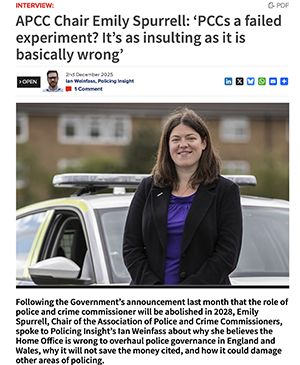
While the lack of a police reform white paper continues to create uncertainty in the UK, the decision taken by the Government to abolish the role of police and crime commissioners (PCCs) from 2028, primarily on the basis of cutting costs (the move will generate an estimated £20 million annually, enough for an additional 320 PCs across England and Wales) has exacerbated the lack of clarity.
Ian Wiggett’s analysis of the background to the decision, and what will replace PCCs, raised as many questions as it answered, and highlighted the complexities around ending one “failed experiment” without a precise idea of the governance model that will follow.
Some of those issues may have been more effectively addressed by working with the Association of Police and Crime Commissioners (APCC) ahead of the decision, but in an interview with Policing Insight’s Ian Weinfass, APCC Chair Emily Spurrell was quick to point out the complete lack of consultation before the public announcement.
There has been understandable speculation that the move is a precursor to a significant restructuring of policing, down from the current 43-force model to around 12-15 larger forces (something the Met Police Commissioner Sir Mark Rowley has previously advocated).
The UK reform white paper will also need to address the funding conundrum. There were warnings at the start of 2025 over the challenges around policing funding for the 2025-26 financial year – despite the announcement of an additional £1 billion for policing – and the vagaries of the police funding formula.
In the last APCC column for Policing Insight before Christmas, Roger Hirst, Police, Fire and Crime Commissioner for Essex and APCC Joint Finance Lead, highlighted the continuing difficulties over funding, especially in relation to meeting government ambitions around issues such as violence against women and girls (VAWG) and knife crime.
Systemic and operational challenges
There’s no doubt that policing in the UK and internationally is facing significant challenges. A report by HM Inspectorate of Constabulary and Fire & Rescue Services Public (HMICFRS) in April into the way UK police investigate crime found that confidence in policing is being eroded as resources are depleted, officers are overwhelmed by increasing workloads, and time pressures do not allow for staff to develop an “investigative mindset”.
The National Audit Office (NAO) report into police productivity argued that the current 43-force structure leads to a “fragmented” approach to data collection around productivity – another issue which may be addressed by that long-awaited reform white paper.
Several reports have highlighted some of the institutional and cultural barriers to various transformation efforts within forces, including the Scottish Institute for Policing Research’s study focusing on implementing anti-racist strategies in UK policing, and an independent review of systemic racism and discrimination in the Metropolitan Police.
The issue of a perceived rise in violent crimes and weapons offences in Australia has become as much of a political talking point as Canada’s bail reforms; a series of articles republished in Policing Insight this year took a closer look at what the statistics suggest is really going on, and what governments and police could be doing to tackle the issues.
To address similar challenges, the Australia New Zealand Policing Advisory Agency (ANZPAA) published its revised Anti-Racism and Cultural Diversity Principles, designed to provide a framework for police “to address racism and strengthen collaborative partnerships”.
In Canada, one of the biggest political conversations in relation to policing has been bail reform, a hotly debated topic during the country’s federal election, and one which – following a number of serious offences, including the murder of an Ontario police officer, being committed by offenders on bail – remained a key talking point. Matthew Wood’s detailed exploration of the background to the debate, the views of various stakeholders, and the prospects of significant reform, was an important read on the subject.
The issue of a perceived rise in violent crimes and weapons offences in Australia has become as much of a political talking point as Canada’s bail reforms; a series of articles republished in Policing Insight this year took a closer look at what the statistics suggest is really going on, and what governments and police could be doing to tackle the issues.
Ian Wiggett’s annual deep-dive into the police workforce figures in England and Wales revealed some of the realities of recruitment, retention and funding, and underlined just how difficult it is likely to be for the Government to meet its commitments on policing.
One UK Government commitment already coming into place is the Neighbourhood Policing Programme (NPP) and a pledge of 13,000 additional officers in the role; Chief Superintendent Andy Sidebotham, Head of Uniformed Policing at the College of Policing, spoke to Policing Insight about the reasons for introducing the NPP, the make-up of the training modules, and what the new programme aims to achieve.
However, the success of the NPP will come down to more than just officer numbers, as illustrated by a report warning that the Neighbourhood Policing Guarantee can only succeed if there is better training for neighbourhood policing recruits, a reduction in officer abstractions from neighbourhood policing teams, and greater recognition of the neighbourhood role as a specialism.
Responding to domestic abuse and family violence
Policing Insight’s thematic report on evolving UK and international police responses to domestic abuse (DA) and family violence spoke to 13 experts on DA from the policing, academic, and NGO spheres, and featured a wealth of research including dozens of published police organisation and government reports and academic papers.
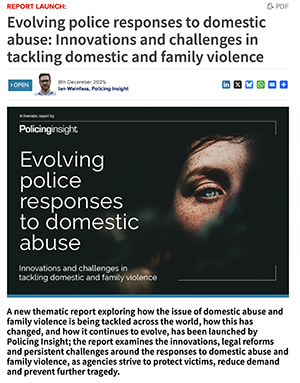
Among the wide range of topics covered, the report revealed the continuing challenges in policing coercive control, and the different approaches jurisdictions are taking to it – an issue highlighted by the Centre for Women’s Justice warning that UK victims of coercive control are being failed by a criminal justice system that often treats them as offenders.
A study by the Australian Institute of Criminology found that the overwhelming majority of victims backed criminalisation of such manipulation, a move that has already taken place in New South Wales, Queensland and South Australia
Police-perpetrated domestic abuse (PPDA), another topic explored in the report, was the subject of a review by the Independent Office for Police Conduct, following the investigation of a ‘super complaint’ into how force’s in England and Wales have responded to the issue. The “organisational silence” around PPDA in the UK was explored in research published by Dr Clare Rawdin, Dr Sarah Wallace and Professor Emma Williams, while a report into police-perpetrated family violence in Australia’s Victoria Police called for a “paradigm shift” away from the force’s role in responding to family violence.
Focusing more widely on the perpetrators of DA and family violence can also deliver positive results, as demonstrated by the Vulnerability & Policing Futures Research Centre comparison of response in Victoria Police and Greater Manchester Police – although there are significant difficulties around successfully implementing support and change programmes for perpetrators of DA when services for victim/survivors are still inadequate.
There is little doubt though that DA and family violence continue to represent both a major part of the demand on police forces, and a complicated and multi-layered crime that often requires a sophisticated response.
Groundbreaking research by University of Cambridge Doctoral Researcher Mags Lesiak revealed how perpetrators of repeat abuse “weaponise attachment” by using grooming, trauma-sharing, and emotional manipulation to coerce victims – a relationship that many professionals including police wrongly dismiss as ‘codependency’.
The necessary complexity of that response was demonstrated in three articles in particular. The need for services and support for adolescent domestic abuse victims came under the spotlight through new research by Gloucestershire Deputy Chief Constable Katy Barrow-Grint and City St George’s, University of London Senior Researcher Dr Ruth Weir.
Noor Da Silva, a Sexual and Domestic Abuse Service Manager in the UK’s East Midlands and one of the country’s 15 specialist Harmful Cultural Practice IDVAs, identified the gaps in current domestic abuse risk assessment tools which disproportionately endanger minoritised women.
And groundbreaking research by University of Cambridge Doctoral Researcher Mags Lesiak revealed how perpetrators of repeat abuse “weaponise attachment” by using grooming, trauma-sharing, and emotional manipulation to coerce victims – a relationship that many professionals including police wrongly dismiss as ‘codependency’.
There have, however, been success stories in the sector; pilots of a new approach to domestic abuse response in Avon and Somerset, where police officers work with independent domestic violence advisors to visit victims more quickly after offences, have achieved more engagement and support referrals for victims and greater support for police action. Essex Police’s decision to assess and tackle perpetrators using similar techniques to fighting organised crime has also delivered impressive results.
And the success of South Australia’s domestic violence disclosure scheme (another issue covered in Policing Insight’s thematic report), which achieved a 99% satisfaction rate from applicants, has been hailed as a blueprint for other jurisdictions.
Tackling violence against women and girls
An NAO ‘value for money’ report published at the start of the year into the work of the UK Government and Home Office to tackle VAWG warned that efforts to improve the outcome for victims had largely failed up to that point. Six months later a report from the Public Accounts Committee found that government officials don’t understand the true scale of VAWG and have “starkly different” views on available support to those expressed by local agencies and victim-survivors.
One positive policing step in England and Wales was the launch of the new National Centre for VAWG and Public Protection (NCVPP), as part of an approach to start “treating the epidemic of violence against women and children with the seriousness it deserves”.
One positive policing step in England and Wales was the launch of the new National Centre for VAWG and Public Protection (NCVPP), as part of an approach to start “treating the epidemic of violence against women and children with the seriousness it deserves”, as NCVPP Deputy Director, Assistant Chief Constable Claire Bell, explained.
And there’s plenty of evidence of innovative approaches to the issue in forces, such as Kent’s Operation Voice, which overlaid road traffic data onto data for VAWG to identify and apply “relentless pressure” to high-harm perpetrators, and Project Minerva, a collaboration between Essex Police and Nottingham Trent University, using data-driven mapping to highlight offences of VAWG as well as identify areas where the fear of crime is greatest.
A landscape review of the police response to online and technology-enabled VAWG, carried out by the Centre for Protecting Women Online, highlighted the changing nature of aspects of VAWG, and called for a national operating model and greater collaboration between forces, as review co-author Giles Herdale explained to Policing Insight’s readers.
The police use of AI and the cyber threat
Artificial intelligence (AI) has once again been held up as both a potential lifesaver and unmitigated threat for policing during 2025, so it’s no surprise that the year has a seen a wealth of reports, events, and commentary on AI, many of which have been covered in Policing Insight.

Among those that particularly stood out were the Beyond Bureaucracy conference on AI in the criminal justice system, the Policing Tech Forum session on the ‘nearly limitless’ opportunities for AI, and the call from the Alan Turing Institute for UK policing to “get serious” about the threat posed by AI by creating a new taskforce to tackle the issue.
The use of AI in predictive policing – once regularly dismissed with cliched references to the film Minority Report – is becoming an increasingly viable option provided the right safeguards are in place, according to research by the academic founders of the Predictive Policing Network. The need for those safeguards, particularly around the risks of “AI bias” in law enforcement, were reinforced by Europol’s report over the summer.
James Sweetland’s interview with Humberside Police Chief Digital and Innovation Officer Scot Dunn offered a revealing insight into how AI can play a vital role turning around the fortunes of a force, and many forces are already embarking on their own journeys with the new technology, in a range of different applications.
In the UK, these include AI-enabled cameras being used to identify bad driving on roads in Devon and Cornwall, an AI-based image filter introduced in Derbyshire to help protect police officers and staff from exposure to indecent images, and an AI model developed by Cheshire Constabulary to spot stalking behaviour and provide early identification of offending patterns. This year could also see the further roll out of AI post-call analysis, already successfully piloted by West Yorkshire Police.
The potential of AI as a valuable tool in the fight against online child sex abuse material – partly to relieve some of the burden on human investigators – was highlighted in a report from the Australian Institute of Criminology, although there were also warnings that many would-be AI solutions are still not fit for purpose.
Alongside accountability, transparency and the need for human input, caution remains a key word in policing’s embrace of AI. According to Florida Institute of Technology forensic psychologist Dr Brandon May, there are already fears that policing is becoming over-reliant on AI – particularly generative AI in areas such as investigative interviewing – and new UK research argued that while AI may offer valuable advantages, public trust and confidence also depend on the quality of interaction with individual officers, so ‘street craft’ and communication skills will remain crucial.

Alongside the increasing use of AI by both police and criminals, the cyber threat is real and common to almost every jurisdiction. Canada’s National Cyber Threat Assessment for 2025-26 highlighted a range of risks facing the country, including those posed by state actors as well as the growing prevalence of criminals using the cybercrime-as-a-service business model.
Unsurprisingly given the global nature of computer networking, the cybercrime threat is recognised internationally; a new report by Europol and Eurojust highlighted the huge volumes and difficult access to data, as well as the legal and logistical difficulties of cross-border investigations, as among the key challenges for European forces.
International approaches to cybercrime – and how they can benefit Australian policing in particular – were the focus for research by Queensland Police Service Detective Chief Inspector Michael Newman, whose report on the subject for the Winston Churchill Trust (a regular source of insightful studies) is well worth a read.
The scourge of child sexual abuse
The Financial Action Task Force (FATF) has explored the financial drivers behind online child sexual abuse and exploitation (CSAE), with live-streamed sexual abuse and the ‘sextortion’ of children creating millions of embarrassed and vulnerable young victims around the world every year.
Online CSAE is clearly another global problem with articles this year covering the work of South Australia’s Joint Anti-Child Exploitation Team to protect children and arrest offenders involved in online child sexual exploitation, and Policing Insight’s Andrew Staniforth’s report on the inaugural INTERPOL Youth Cybercrime Awareness Webinar.
The report from Childlight, the Global Child Safety Institute into the financial mechanisms enabling online CSAE, and what can be done to target the institutions, tech companies and online payment platforms that are profiting from this multibillion dollar “grotesque marketplace”, is another important read.
As such, international collaboration is vital – a message reinforced by the cybercrime analyst Paul Raffile and financial investigator Detective Brad Thorne, when they spoke to Policing Insight about the scale of online sextortion cases which have led not only to embarrassment but a surge in teen suicides.
Given the financial drivers identified by the FATF, the report from Childlight, the Global Child Safety Institute into the financial mechanisms enabling online CSAE, and what can be done to target the institutions, tech companies and online payment platforms that are profiting from this multibillion dollar “grotesque marketplace”, is another important read.
Clearly not all CSAE happens online, and an analysis by the Vulnerability Knowledge Practice Programme of police-recorded CSAE in the UK highlighted the scale of the crime found that almost a third of cases happen within a family context; but the study also warned that the threats involving technology, from social media platforms facilitating the distribution of material to AI generating “fake” child sexual abuse imagery, represented a significant risk to children in the future.
Worryingly, new research into the organised ritual abuse of children and adults in England and Wales indicated that detections and convictions for such offences are likely to be the “tip of the iceberg”, and suggests that policing and other agencies need to take seriously “the prospect of multiple undetected homicides”.
Public order policing and the responding to those in mental health crisis
The tensions around public order policing are nothing new, and it was a valuable reminder to have two of Policing Insight’s regular contributors – Martin Gallagher and Graham Wettone – reflect on their experiences of policing the G8 Summit in Scotland 20 years ago.
Graham’s assessments of some of the current public order policing scenarios facing forces in the UK – from policing Notting Hill Carnival to asylum seeker and Palestine Action protests, as well as the complex laws around policing marches and protests – provide an expert analysis of some of the main issues.
The police response to modern public order challenges had already come under the spotlight following a series of riots across England and Wales in the summer of 2024, and the first report in a two-part review by HMICFRS praised officers for their “immense bravery”, but highlighted concerns over the capacity, capability, and speed of the response, as well as the wellbeing support for frontline officers.
Similar concerns were raised by Ontario Inspector General of Policing Ryan Teschner in his review of the policing of protests and major events, which pointed to the increased frequency and complexity of demonstrations leaving officers stretched too thin.
The response to those in mental health crisis is also placing significant demands on already stretched resources, and forces around the world are understandably looking for more effective ways to meet that demand.
In Lancashire a mental health diversion and advisory panel initiative offers an alternative out-of-court disposal approach to mental health-related offending that is winning support from officers as well as those in crisis.
The Right Care, Right Person (RCRP) response, pioneered by Humberside Police before being rolled out across most forces in England and Wales, is “front and centre” of the National Police Chiefs’ Council (NPCC) Mental Health and Policing Strategy, and is being considered by other jurisdictions internationally; there was also a call from those who developed the approach to ensure it’s not diluted. But it’s certainly not perfect, as an evaluation by the Home Office and the Department of Health and Social Care revealed earlier this year.
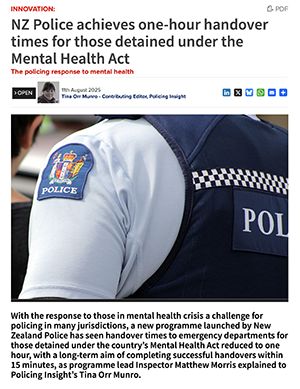
New Zealand Police have approached the problem from a different angle, successfully working to reduce handover times to emergency departments for those detained under the country’s Mental Health Act reduced to one hour under the service’s Mental Health Response Change Programme strategy.
The mental health crisis in policing
Welfare concerns have been a major issue for police forces for at least two decades; the latest UK Oscar Kilo survey suggests things are still not improving, and the launch of a 24/7 Mental Health Crisis Line for officers and staff underlines the scale of the problem.
These concerns are not limited to the UK. Research among officers from Australia, New Zealand, and England and Wales found “a tsunami” of PTSD and poor mental health, and prompted a call from research co-author Dr Alan Beckley for more “empathetic and caring” managers and leaders.
New research by the Open University’s Lucy Davies explored how the unprocessed trauma experienced by many officers can quietly erode judgement, and in some cases lead to the very misconduct that undermines public trust. While those operational stressors were also highlighted by Dr Cody Porter and Dr Paul Gavin in their research into specific sources of stress, so too was the damage caused by ‘organisational’ stressors.
It’s clear that while the nature of the policing role has always been stressful, and continued exposure to traumatic incidents almost inevitably takes its toll, it is the policing organisations themselves, and their often inadequate response to the wellbeing struggles experienced by their own officers and staff, which can significantly exacerbate problems.
The stigma around officers and staff seeking help for mental health issues is still a major concern, as highlighted by research into the struggles of public protection officers in Scotland, and the views of officers in Northern Ireland around the “internal enemies” of institutional support. Dr Rachel Rogers article on why male police officers often delay so long before asking for help, and why labels such as “sick, lame and lazy” become more than just words, offered further insight into a problem that is in part of policing’s own making.
It’s clear that while the nature of the policing role has always been stressful, and continued exposure to traumatic incidents almost inevitably takes its toll, it is the policing organisations themselves, and their often inadequate response to the wellbeing struggles experienced by their own officers and staff, which can significantly exacerbate problems.
Fortunately, there are pockets of progress and good practice in relation to police mental health. The Suicide Trauma Education Prevention (STEP) initiative initially launched in Hampshire Police is now looking to extend nationally and raise awareness among senior UK officers, as founder Spencer Wragg told Policing Insight’s Sarah Gibbons.
This year ANZPAA launched its Principles for Mental Health and Wellbeing in Policing, aiming to provide an actionable, proactive framework for a “modern, resilient, and mentally healthy policing environment”.
And peer support programmes are providing vital support for officers around the world, from the external agency approach offered by Canada’s Badge of Life organisation, to the trauma support offered by officers and staff in the Metropolitan Police.
New technology
It was little surprise to hear Chief Constable Rob Carden, Chair of the NPCC’s Digital, Data and Technology Co-ordination Committee, urging police forces across England and Wales to “embrace technology in a way we’ve never done before”, to ensure they can play their part in delivering the Government’s Safer Streets Mission.

That message was delivered at the techUK Justice and Emergency Services Conference in May, and was echoed again when the NPCC partnered with the Police Digital Service for a highly successful Innovation and Digital Summit in Liverpool in October; it was also encouraging to see the UK’s new National Policing Digital Strategy launched in July.
Individual forces are taking that message to heart, and embracing technology in new and exciting ways. A Dorset Police trial which expanded the video response approach used with domestic abuse cases to a wider range of calls and crimes has seen significant increases in arrest rates, positive outcomes and satisfaction levels for victims, and potential savings of £1.5million.
In Hertfordshire the roll out of an evidence storage and sharing app saw positive outcomes more than double compared to the force average, reducing investigation times and helping officers to link crime patterns – a move that enables the force-wide “investigative mindset” called for by the HMICFRS.
A life-saving biometric monitoring system introduced into custody cells in Canada’s Regina Police Service is believed to have saved multiple saves since it was implemented.
But technological development is not without its difficulties. When Ian Weinfass spoke early in 2025 to those leading on the project to replace the UK’s Police National Computer with the new Law Enforcement Data Service (a switchover due to happen in the next few months), they were clear about the challenges over the change in the system, and the potential implications of not hitting the target date.
And policing in some instances is also playing catch-up with early criminal adoption of new technology. A New Zealand Police multi-disciplinary approach to tackle the threat of illicit 3D printed firearms – a tool favoured by organised crime groups – also underlines the benefit of international collaboration.
Innovative initiatives
Innovation, however, isn’t just about technology. For example, Operation Makesafe is the nationwide policing initiative working with hotels and accommodation providers across England and Wales to target and prevent premises being used for child sexual exploitation.
An evaluation of the ‘Clear, Hold, Build’ programme to tackle serious and organised crime (SOC) implemented across almost all territorial police forces in England and Wales, found that the approach is successfully driving down acquisitive crime and promoting partnership approaches. The evaluation of a West Midlands Police pilot deterring young people from being drawn into SOC by using a ’carrot and stick’ approach also achieved encouraging results.
And a multi-agency initiative led by Leicestershire Police – working with fast-food chain McDonalds, the local authority, St John’s Ambulance and other partners – has seen serious violence in parts of the city’s might-time economy cut by half, leading to a global problem-solving in policing award.
One of the most striking interventions is the Offender 2 Recovery (O2R) programme tackling retail crime pioneered in the UK by West Midlands Police; by providing life-saving support to get addicts off of drugs, the approach is already believed to have saved millions of pounds annually through the reduction in shoplifting.
Perhaps one of the most striking interventions is the Offender 2 Recovery (O2R) programme tackling retail crime – another challenge facing policing internationally – and pioneered in the UK by West Midlands Police.
By providing life-saving support to get addicts off of drugs, the approach is already believed to have saved millions of pounds annually through the reduction in shoplifting and other thefts. When National Business Crime Centre Lead, Superintendent Lisa Maslen, told Policing Insight that forces should proudly borrow best practice in the fight against retail crime, the O2R initiative would seem to be a prime example.
Early feedback from New Zealand Police’s development of a ‘solution-focused approach’ to interactions – both with the public and within force – as a way to improve outcomes for the community as well as officer wellbeing suggests the approach could be truly transformative.
Of course, innovation is not the sole preserve of policing; criminals are also maximising the potential offered by technological advances and changing landscapes. The series of articles on the trafficking of chemically concealed cocaine by organised crime expert Chris Dalby was as eye-opening as it was practically informative (as were his articles on organised crime and sport).
The challenges around drug enforcement are not getting any easier, and not just because of criminal adaptability. Research carried out by RAND and commissioned by the UK Home Office, which explored global literature in English, Dutch, Spanish and Portuguese on the impact of drug-related law enforcement activity on serious violence and homicide, suggested that drug-related law enforcement interventions can drive further violent crime rather than reducing it.
The view from the top?
A number of senior police leaders have spoken to Policing Insight over the past 12 months to offer an insight into their attitudes to leadership and approaches to policing challenges.
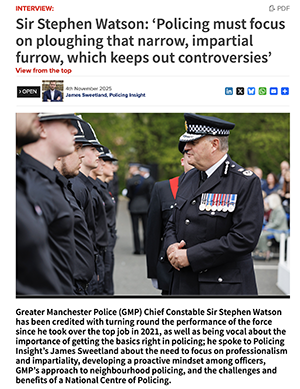
One of the most revealing from a UK perspective was Greater Manchester Police Chief Constable Sir Stephen Watson’s conversation with James Sweetland, which covered everything from his labelling by the media as an “anti-woke cop”, to developing a proactive mindset among officers and his force’s approach to neighbourhood policing.
Other UK leaders and senior officers who spoke in-depth to Policing Insight included City of London Police Commissioner Pete O’Doherty, Essex Chief Constable BJ Harrington, HM Chief Inspector of Constabulary for Scotland Craig Naylor, and College of Policing CEO, Chief Constable Sir Andy Marsh.
Montreal City Police Chief Fady Dagher’s interview with Christine Townsend highlighted what seems to be a unique approach among a range of measures to create a new policing culture and more cohesive communities – an Immersion Programme where officers live with host families to gain a better understanding and insight into the everyday challenges they face.
Other senior Canadian officers and policing leaders to share their views with Policing Insight this year included Saskatoon Police Service Chief Cameron McBride, Chief Dale McFee of Edmonton Police Service, and Ontario’s first Inspector General of Policing Ryan Teschner.
Commissioner Krissy Barrett, who took up the top job in the Australian Federal Police in October, Commissioner Donna Adams, celebrating her first two years in post leading Tasmania Police, and the newly-appointed CEO of ANZPAA, Carl McLennan, were among the police leaders who all spoke to Policing Insight’s Sarah Gibbons about their insights into the challenges facing policing in Australia and New Zealand.
And Iceland’s National Police Commissioner Sigríður Björk Guðjónsdóttir explained to Sarah the need to keep pushing for greater gender equality, the new approaches to responding to domestic violence, and why appointing senior leaders from outside of policing helps to change potentially damaging cultures.
Thank you again to these and all the other senior police leaders who took the time to share their views with Policing Insight’s audience during 2025.
What next?
While in the UK the reform white paper will hopefully (eventually) address many of the structural concerns, Home Secretary Shabana Mahmood’s briefest of appearances at the joint APCC and NPCC summit in November just days after the abolition of PCCs – where she refused to take questions from the floor or from journalists following her speech – did little to instil confidence.
Many in UK policing will be keen to see the Government’s pledges on issues such as VAWG, knife crime and Neighbourhood Policing succeed; but working with the wider police family, rather than dismissing consultation and input from those doing the job, will be crucial to that.
Many in UK policing will be keen to see the Government’s pledges on issues such as VAWG, knife crime and Neighbourhood Policing succeed; but working with the wider police family, rather than dismissing consultation and input from those doing the job, will be crucial to that.
Of course, geopolitical events and wider political developments completely outside of policing’s control will doubtless have an impact on the work of law enforcement officers and staff throughout 2026.
It remains encouraging to see the amount of research ongoing into many of the policing and criminal justice issues we’ve featured in 2025, and we will continue to cover that research – both through our regular features, and through the Weekly Academic Research Summary expertly curated by our Academic Editor, Dr Carina O’Reilly.
Carina is also playing a vital role in ensuring that this research, along with other academic theory and its implications for operational policing, reach the next generation of police officers, through the ongoing series of The Police Student, which is currently exploring community and neighbourhood policing, with a further eight topics to be covered over the next few months.
Our Media Monitor service will continue to bring you the latest global policing news, analysis and opinion through the Daily Brief, and for those of you who prefer to watch rather than read interviews, comment, discussion and conference sessions, our sister site, PolicingTV, offers video coverage of everything that’s important to policing.
But internationally, one thing that has stood out in much of our coverage over the past 12 months is the shared nature of many of the challenges faced by policing around the world.
From AI and new technology to VAWG, domestic abuse, officer welfare and leadership approaches, it’s clear that policing organisations have a wealth of good practice to share, and huge opportunities to collaborate on new and proven ideas.
Policing Insight’s aim in 2026, as always, will be to identify those potential opportunities and facilitate the learning and sharing of best practice across our global audience.