
Internet Intelligence and Investigations Conference 2024: The rise of the machines
ADVERTISEMENT FEATURE: Register for this year's Internet Intelligence and Investigations Conference taking place 18-20 June 2024.

ANALYSIS: As political parties in the UK begin their election campaigning in earnest, a Conservative proposal for a new national service scheme – which would include options for young people to undertake their service in ‘civic duties’ including policing – has prompted much debate; Policing Insight’s Ian Wiggett looks at how the scheme might work, what happens elsewhere, and the possible challenges and benefits.
ANALYSIS: The concept of coercive control has been recognised for more than 15 years, and coercive and controlling behaviour was introduced as a criminal offence in 2015; but research by Julia Pitman, justice policy, campaigns and research professional, highlighted key barriers the police face in recognising female offenders as victims of coercive control, including lack of officer skill and experience, and inadequate policy and guidance.
FEATURE: In this penultimate article in the current series of The Police Student focusing on Criminology in Policing, Policing Insight Academic Editor Dr Carina O’Reilly explores control theories, which concentrate not on why an individual is motivated to offend, but what persuades them not to, and what society – and officers – can do to support people to stop offending.
ANALYSIS: In the first in a series of four articles, Policing Insight’s Matthew Wood explores the core characteristics, shaping mechanisms, and perspectives on police culture; by examining both the positive aspects and challenges of police culture, the series aims to provide deeper insights into its impact on everyday policing, and explore pathways for meaningful reform.
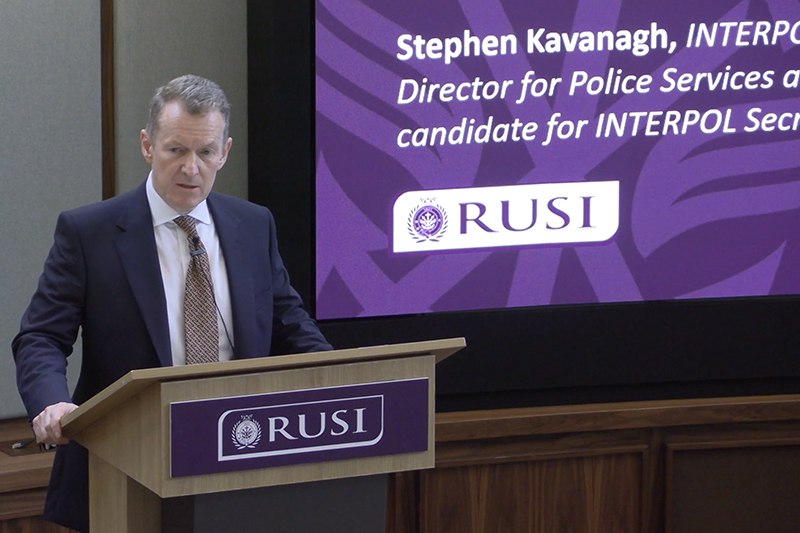
FEATURE: Interpol Executive Director of Police Services Stephen Kavanagh has warned that a new international “poly-criminal age” is posing harm to millions around the world, and that while Interpol remains uniquely placed to lead the response, it will require a “global mindset” from law enforcement, government, communities and the private sector to tackle the threat, reports Policing Insight’s Keith Potter.
OPINION: In a response to an earlier article exploring the strategic direction of Police Scotland, former President of the Association of Scottish Police Superintendents Prof Niven Rennie argues that financial constraint – both in policing and across the public sector – is a key factor in determining the priorities for the force, and calls for support for Chief Constable Jo Farrell’s efforts to navigate these challenges, as well as a more unified public sector approach.
INNOVATION: In the latest in a series of articles exploring the opportunities and challenges presented to police by the rapid growth of artificial intelligence (AI), Chief Philip Lukens explores implications of synthetic identities, how they can be adopted and exploited for criminal use, and the strategies law enforcement needs to put in place to combat them.
INTERVIEW: A new report from the UK’s National Rural Crime Network has highlighted the role of organised crime in many of the machinery thefts devastating farming communities; Policing Insight’s Sarah Gibbons spoke to Northumbria Police Superintendent Andy Huddlestone, head of the National Rural Crime Unit, about the need for better data sharing, more resources, and greater prioritisation by forces to tackle a growing crime trend.
OPINION: Police in Scotland were among the frontrunners on officer safety training and de-escalation techniques, prompted in part by the tragic on-duty murder of PC Lewis Fulton almost 30 years ago; but Michael Greville, a former long-serving officer who played a key role in developing the officer training programme, believes Police Scotland needs to address a significant gap between training and operational application that leaves officers and the public at risk.
OPINION: Alongside the estimated $60 billion costs to Australia and Australians of transnational serious and organised crime (TSOC), there are significant impacts on individuals and communities, political stability, and the environment; Dr John Coyne, head of the Australian Strategic Policy Institute’s Northern Australia Strategic Policy Centre, believes the time is right for a TSOC white paper to address this multidisciplinary, complex challenge.
OPINION: In this opinion article former Police Scotland superintendent Martin Gallagher gives his views on some of the challenges facing his former force, and why Chief Constable Jo Farrell is right to call for reform of three key areas – the courts process, policing mental health, and the response to minor crime – but argues that proposals put forward are unlikely to succeed.
OPINION: Police Foundation Director Rick Muir believes that the potential for citizen volunteering in police and public safety has been neglected for too long, and points to the success of volunteering approaches in a number of other countries including the US and Japan as an indication that placing citizen participation as central to policy discussions could help to solve some of the big challenges UK policing faces.
ANALYSIS: The Police Constable Degree Apprenticeship (PCDA) is a key entry route into the UK police service; but Donna Eastham, Programme Lead for Professional Policing at Leeds Trinity University, warns that issues such as a lack of informed understanding or commitment to academic learning among employers, the impact of ‘war stories’, and the ‘inbetweenness’ degree apprenticeships create for policing students could all have damaging consequences for the success of the PCDA.
OPINION: With communities across Canada considering whether the Royal Canadian Mounted Police should be responsible for municipal policing, the city of Surrey in British Columbia has become one of the first to look to replace it with a newly-formed Surrey Police Service; but Royal Roads University Lecturer Dr Bryce Casavant believes the controversy and conflict between the RCMP and Surrey Police highlights the challenges around the transition.
OPINION: In an opinion piece that sets out to challenge UK policing’s “intellectual and doctrinal confusion”, recently re-elected Wiltshire PCC Philip Wilkinson argues that most of the public “feel abandoned to the intimidatory threats of vocal and shrill minorities”, amid concerns over “risk-averse” policing leadership and a perception that forces are failing to police without fear or favour.
INNOVATION: Against the backdrop of changing legislation and technological innovation, police and technology advisor Paul Kennedy, and Josh Hartlage, founder of tech company AdventFS, explore how technologies can help police and other agencies to be more efficient and effective in the application of out-of-court resolutions, guided by the principle that OOCRs should always meet the needs of victims, first and foremost.
ANALYSIS: It’s now six months since the largest pro-Palestinian March in London, and the reaction to the policing of the event that led to the departure of Home Secretary Suella Braverman; as protests around the Middle East conflict continue, highlighted recently with the handling of an antisemitism campaigner’s attempt to walk through a march, Policing Insight’s Graham Wettone looks again at the claims of two-tier policing, the difficulties officers face, and the role politicians play in increasing tension.
OPINION: Australian legislation enabling the repudiation of citizenship of those who engage in terrorism also means that those who commit conflict-related crimes including sexual violence escape prosecution, says PhD scholar Susan Hutchinson of the Australian National University, who calls for a new dedicated unit in the Australian Federal Police to investigate and prosecute such crimes.
ANALYSIS: The rising incidence of women’s deaths as a result of male violence in Australia has prompted some to call for the wider use of domestic violence disclosure schemes, but research by Monash University Professor Dr Kate Fitz-Gibbon, and Lecturer Ellen Reeves and Professor Sarah Walklate of the University of Liverpool, suggests such schemes can put victim-survivors in greater danger, with resources better invested elsewhere.
FEATURE: Chief constables in England and Wales are planning a strategy to promote policing history and say it will link to the National Police Race Action Plan and their work to prevent violence against women and girls; Policing Insight’s Ian Weinfass spoke to national lead on police heritage Peter Gillett and other experts to explore the issue.
OPINION: With many discussions around what policing’s core mission should entail and how it should be achieved, author, lecturer and former Police Scotland superintendent Martin Gallagher argues that a more Platonic philosophical approach to the debate could deliver some benefits in determining the role and remit of the service.
FEATURE: With money laundering continuing to pose a threat to security and safety through the use of funds for both criminal activity and terrorism, Policing Insight’s Andrew Staniforth reports on the latest European Union agreements which should improve detection and strengthen prevention across members states.
INTERVIEW: This month Avon and Somerset Police became the first UK force to launch an advocacy service for victims and witnesses of sexual misconduct within the workplace; Policing Insight’s Sarah Gibbons spoke to Vicki Moore, the force’s first Sexual Misconduct Liaison Officer, about the support that will be available to those reporting misconduct, the benefits to public trust and confidence, and the potential to expand the service to more issues.