

From communications and record management to data analysis and interoperability, the results of the UK Police Digital Experience Survey 2025 will highlight both the benefits and challenges from the digital technology currently in use across policing in the UK.
The technologies that we’re using now, I think are definitely moving towards taking some of that pressure off, and that in itself is going to help us deliver a much better service to people.”
Aimee Edwards, VCO,
Gloucestershire Constabulary
And for Gloucestershire Victim Care Officer Aimee Edwards – one of 6,678 officers and staff who completed the survey – supporting the survey by sharing her views and experiences of policing’s digital transformation has landed her with her own piece of cutting-edge technology.
With all of the respondents entered into a prize draw, Aimee’s name was selected as the winner, and she is now the proud owner of a Samsung Galaxy Watch 8 fitness watch.
Aimee joined Gloucestershire Constabulary’s Victims Hub when it was launched just over two years ago, having worked as a receptionist for the force for the previous five years, and in both roles she has seen the changes that new technology has brought to the job.
“There’s quite a wide array of how we contact people now,” explained Aimee. “We’ve replaced desk phones with Microsoft Teams, so when we’re calling people we’re using Teams.
“We’ve got people who it’s easier for us to email because of their time commitments, and some people prefer text message, so we’ve got mobile devices that we can send text messages from.
“And once a domestic abuse case has been reported to the police, officers can now do video calls, so they can see the person and do all the checks that an attending officer might be able to do, without relying on having that resource there to send to someone.
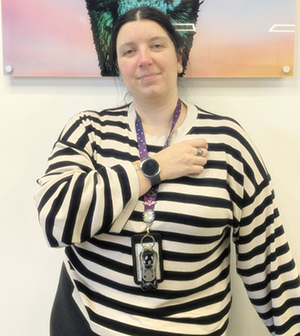
Prize-winning Gloucestershire Constabulary VCO Aimee Edwards with her Samsung Galaxy Watch 8
“So the technologies that we’re using now, I think are definitely moving towards taking some of that pressure off, and that in itself is going to help us deliver a much better service to people.”
Aimee, like many of her colleagues across forces who completed the survey, is also well aware of the differences that the introduction of new technology can make, whether simple updates and new equipment or major technology programmes.
“We’ve had little things – like when we first started out, the mobile phones that we were texting from were the tiniest things on the planet, so it was quite difficult to text. I always used to get very stressed sending text messages to people, but simply changing the devices we were using made a major difference.
“On a larger scale, we have just changed our main crime recording system so that we are on Niche, much like a lot of the other forces. Wrapping my head around that is a little bit of a headache at the moment.
“But before, we were saying ‘Oh, it would be so nice if a lot of these systems could talk to each other’, and now we’re moving onto this system where it does talk to all the other systems. Instead of having four or five different programmes for which you might need four or five different training sessions, just having it all on Niche will be a lot more interactive.”
Bridging the gap
While the technology is changing within Aimee’s job, the role itself is another indication of how policing is continually evolving and looking to improve the service its delivers.
“There were a few things that had been noticed in terms of victim contact and that sort of thing, that warranted putting a whole department in for us to help with that, which is how the Victims’ Hub was born,” continued Aimee.
“Myself and some other willing colleagues came in at the start of the Hub, to try to bridge that gap in the contact between officers and victims. Investigations can get quite in-depth and things can go a bit quiet for a while, and we had a lot of people saying that they didn’t know what was happening with their case and they weren’t getting the update as regularly as they would like.
There are obviously some very stressful cases, but generally the people that we speak to are very grateful for our contact even if they’re not wanting anything. In terms of engagement between members of the public and the police, I think it has done wonders.”
Aimee Edwards, VCO,
Gloucestershire Constabulary
“So we, as I say, bridged that gap. We usually do monthly updates for victims just to let them know what is going on. Even if there is no investigation update, we still touch base with the victim just to check how they’re doing and see if there’s any extra support that they might need from anywhere.
“It’s worked wonders in terms of things like Victims’ Code of Practice compliance – it’s really helped with that. And we’ve also done things like helping officers with taking victim personal statements, and completing special measure applications for court, which takes a little bit of pressure off the officers as well, because they are absolutely loaded to the nines and trying to deal with all their cases.”
Currently the victim care officers in the Gloucestershire Victims Hub only deal with domestic abuse and hate crime cases, although Aimee can see the benefits of extending that service to all enhanced rights crimes, “just to make sure that we are keeping those victims up to date”.
“We do get a lot of victims who are very, very grateful that we are in contact with them. And certainly I’ve got victims who aren’t necessarily interested in pursuing the case or prosecuting, but they still want to know what’s happening. It almost puts the power back in their hands a little bit as to what they want to do.
“There are obviously some very stressful cases, but generally the people that we speak to are very, very grateful for our contact even if they’re not wanting anything. In terms of that public engagement between members of the public and the police, I think it has done wonders.”
The unfiltered picture
Aimee’s views on the use of technology in her own role were among the thousands of experiences shared by officers and staff from 46 UK forces, which will help to provide an accurate picture of what works – and what doesn’t – in terms of digital technology, particularly for those on the frontline.
The survey was conducted by Policing Insight during the autumn of 2025, powered by Qualtrics and supported by the Home Office, the National Police Chiefs’ Council (NPCC), the Police Federation of England & Wales, and the Police Digital Service.
It was open to all officers and staff at UK police forces, giving them the opportunity to describe their experience of digital, data and technology provision – both in their own force and nationally – to influence those who are developing the future of that provision.
The participants completed 22 questions on their digital, data and technology provision including overall satisfaction, reliability, interoperability, availability of devices/systems, training, and data quality, generating both quantitative and qualitative feedback from comment opportunities on the questions.
It’s the largest frontline listening exercise in police digital provision, and while there were fantastic responses from all forces, Gloucestershire, North Wales, Bedfordshire, City of London and Wiltshire led the way with responses in proportion to force size.
It is incredibly important that we understand the importance of feedback from our frontline when aiming to improve our technology provision. DDaT is a key priority within Gloucestershire and it is great to hear that implementations are beginning to have a positive improvement on how we work.”
T/Chief Constable Maggie Blyth
Speaking to Policing Insight, Gloucestershire Temporary Chief Constable Maggie Blyth said: “I was delighted to see that Gloucestershire Constabulary provided such a strong response to the Police Digital Experience Survey, and even more delighted to hear that Aimee Edwards had won the prize draw, congratulations Aimee!
“It is incredibly important that we understand the importance of feedback from our frontline when aiming to improve our technology provision. DDaT is a key priority within Gloucestershire and it is great to hear that implementations are beginning to have a positive improvement on how we work. I look forward to seeing the published report.”
The results of the survey are currently being analysed by Policing Insight’s academic partners at the University of Huddersfield, and will form the basis of the high-profile report to be published in April, which will feature results charts, analysis and stakeholder commentary.
At the launch of the survey, Merseyside Chief Constable Rob Carden, the NPCC Digital, Data and Technology Coordination Committee Lead, said it was vital that forces were able to make technology investment decisions that would drive efficiencies and maximise public safety.
“To do this, we need a true picture of the issues being faced by officers and staff across the UK who, alongside an already challenging day job, are dealing with legacy technology and systems that instead of being helpful, are fast becoming a hindrance,” said CC Carden.
“I am grateful to the team at Policing Insight who, alongside the NPCC Digital, Data and Technology Coordination Committee, have put together a survey to ensure that together, we build that picture and prioritise investment in the right areas.
“My ask to officers and staff across all forces is, what is working and what isn’t when it comes to digital, data and technology? We need to know to help, and want the full, unfiltered picture.”
UK Police Digital Experience: User perspectives report
Policing Insight intends to publish the results of the UK Police Digital Experience Survey in April 2026. With over 6,600 responses from 46 police forces and thousands of comments on the challenges and opportunities of police digital data and technology (DDaT) provision in the UK, this huge frontline listening exercise will provide fantastic insights for government, policing and industry stakeholders.
The survey was conducted by Policing Insight during the autumn of 2025, powered by Qualtrics technology and supported by the Home Office, the National Police Chiefs’ Council (NPCC), the Police Federation of England & Wales, and the Police Digital Service. We have also partnered with the University of Huddersfield to analyse the survey responses.
To find out how your organisation can support the forthcoming report through sponsorship opportunities or how to access the report and survey results, please email [email protected].