

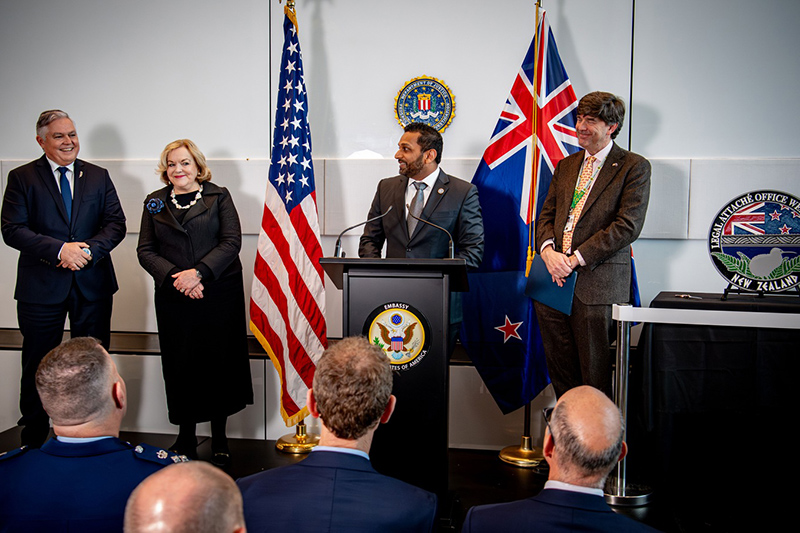
Washington established the position of a Federal Bureau of Investigation legal attaché (known as a legat) in Wellington in July, touting it as bulwark against Beijing and a boost to regional crime-fighting.
Casting the creation of the legat as a geopolitical move and policing tool could undermine the partnerships Australia and New Zealand rely on to jail drug lords and money-launderers.
Yet casting the creation of the legat as a geopolitical move and policing tool could undermine the partnerships Australia and New Zealand rely on to jail drug lords and money-launderers.
Issued on 31 July, the official FBI press release said the upgraded office would contribute to joint policing ventures, such as investigating and disrupting transnational serious and organised crime, terrorism, child exploitation and foreign interference.
In announcing the move, FBI Director Kash Patel talked up broader geostrategic goals. He emphasised that establishment of the position would enable the United States and New Zealand to tackle “some of the most important global issues of our time” including countering China.
An FBI spokesperson echoed these claims, arguing that the legat would be aimed at confronting threats in the Indo-Pacific “particularly from hostile nation-state actors like the Chinese Communist Party”.
While New Zealand Government ministers sought to downplay the China angle, the Chinese embassy in Wellington said that the move reflected a “Cold War mentality”, adding that China had “taken note of the assertions”.
The US announcement implies another geostrategic reason for the move, namely bolstering partnerships. The FBI’s press release noted that the Wellington office would “strengthen and enhance the longstanding co-operation with a key Five Eyes partner”.
Indeed, Patel added that the move was intended to show “the world that the FBI is actually prioritising a permanent presence across all Five Eyes countries”.
US inconsistencies
This may appear to contradict US President Donald Trump’s policy agenda that views alliances with strong scepticism. But unlike defence alliances, policing and intelligence partnerships may be more politically palatable, since their focus is usually operational rather than political. So the emphasis on the Five Eyes may reflect the specific characteristics of the network, and its importance within the Pacific theatre.
Taken together, these inconsistencies muddy the policy intent of the move and likely create headaches in Canberra and Wellington. One particularly affected area would be joint policing initiatives.
However, the opening of the legat office is unlikely to signal any US intention to increase its global policing footprint. As John Coyne wrote in The Strategist in June, the US has recently rolled back aspects of its global law enforcement footprint.
This is most visible in Southeast Asia, with the US Drug Enforcement Administration (DEA) closing key outposts in Myanmar, Indonesia and southern China.
Moreover, Patel has sought to pivot the FBI towards ‘domestic concerns’, including by trying to scale backinvestigative work that focuses on counter-intelligence, national security and public corruption threats.
Yet Patel has a hawkish public stance on China, including identifying it as a national security threat during his confirmation hearings in early 2025.
Taken together, these inconsistencies muddy the policy intent of the move and likely create headaches in Canberra and Wellington. One particularly affected area would be joint policing initiatives.
Threatening co-operation
Australian and New Zealand police work with their Chinese counterparts across several crime themes. For example, Taskforce Blaze – a standing operation between the Australian Federal Police and the Chinese National Narcotics Control Commission – has seized 28 tonnes of illicit drugs and precursors since its inception in 2015.
For its part, New Zealand Police has a host of formal and informal arrangements with China, including a working group on law enforcement co-operation.
The framing of the legat office as a geostrategic initiative to counter Chinese influence could challenge such arrangements. Police co-operation is often conditional on cordial relations between the respective governments.
Indeed, the Chinese embassy in Wellington said that “transnational crime is a common challenge encountered by all countries requiring co-operation to tackle”, and that “relevant co-operation should not target any third party”.
This may also position Australian and New Zealand police officers as unofficial policy brokers. They may become engaged in a kind of diplomacy to maintain cordial relations for the sake of continued co-operation.
Moreover, the framing of the Wellington office combined with the DEA retreat in Southeast Asia may cause regional partners to think the US is allocating policing resources for signalling purposes rather than joint-policing initiatives. Such a perception could jeopardise Australia’s own police-to-police work with China.
This may also position Australian and New Zealand police officers as unofficial policy brokers. They may become engaged in a kind of diplomacy to maintain cordial relations for the sake of continued co-operation. To do so effectively, they may require further government training and resources.
Of course, caution should be maintained with respect to co-operative engagements. Foreign interference operations remain a risk, and police organisations are not immune. Nor should it be taken to suggest that law enforcement can’t act as a force multiplier for broader defence initiatives.
However, a careful balance needs to be struck to continue some co-operation, particularly on combatting transnational crime. For their part, Canberra and Wellington should continue to highlight the benefits of, and successes from, working with regional partners – including China. This can ensure that an important asset such as an FBI legat doesn’t become a strategic liability to policing.
This article first appeared on the ASPI Strategist, and is republished under a Creative Commons Licence; you can read the original here.
Picture: The FBI launches its new legal attaché position in Wellington, New Zealand (© FBI)