

Policing in the Pacific has never been about propping up governments; it has always been about serving communities. Yet Beijing’s introduction of Mao-era community policing into Solomon Islands last week was a sharp departure from this tradition.
While China’s so-called community policing initiative in Honiara may sound benign, it’s anything but. At its core, it imports the Fengqiao Experience: a Maoist approach rooted in surveillance, neighbour-on-neighbour reporting and pre-emptive control of dissent.
If Australia and its partners are serious about being the Pacific’s security partners of choice, they must act now to invest in and reinforce policing models grounded in community service, trust and accountability.
While China’s so-called community policing initiative in Honiara may sound benign, it’s anything but. At its core, it imports the Fengqiao Experience: a Maoist approach rooted in surveillance, neighbour-on-neighbour reporting and pre-emptive control of dissent.
Fingerprinting, palm-print collection, household mapping and registration exercises may be presented as administrative necessities. In reality, however, they are direct intrusions into the lives of Solomon Islanders.
Pacific island nations have historically rejected precisely this kind of model. For decades, policing across the region has been defined not by regime protection, but by community partnership.
From the early interventions of the Regional Assistance Mission to Solomon Islands (RAMSI) to today’s Pacific Policing Initiative, Australian Federal Police (AFP) officers have built trust by embedding themselves alongside local police and investing in investigations, professional standards and community outreach. The legitimacy of policing in the Pacific has come from this principle: that police are there to serve the people, not to protect governments from their own citizens.
The contrast between these two models – Australia’s rights-based policing and Beijing’s regime-protection policing – couldn’t be starker. And yet, the risk is that the Solomon Islands becomes a proving ground for authoritarian practices under the guise of community service.
The quiet collection of sensitive biometric data, absent any parliamentary debate or legislative safeguards, erodes sovereignty and undermines the democratic accountability that Pacific nations have fought to sustain.
A chilling effect
Australia and its partners must recognise that the contest in Honiara isn’t simply about who can deliver more aid vehicles, training programs or infrastructure projects; it is about what kind of policing model will define the Pacific’s future. Will it be one rooted in transparency, rights and service to communities? Or one that normalises surveillance, submission and political control?
This approach sits uneasily alongside the AFP’s contingent of officers focused on capacity building. Rather than coexisting, these two models compete, with the potential to confuse citizens about what policing should mean in their society.
While Solomon Islands’ ‘friends to all’ outlook was adopted in response to this contest, it has also created space for competition to continue. Since switching recognition from Taiwan to Beijing in 2019, Honiara has welcomed Chinese investment in ports, stadiums and policing co-operation.
A bilateral security agreement signed in 2022 opened the door for a permanent Chinese police presence. Today, around a dozen Chinese officers conduct martial arts and weapons training.
This approach sits uneasily alongside the AFP’s contingent of officers focused on capacity building. Rather than coexisting, these two models compete, with the potential to confuse citizens about what policing should mean in their society.
For Beijing, the stakes are clear. Exporting its surveillance-heavy policing model secures tactical influence over Solomon Islands’ politics and begins to reshape regional norms.
A Solomon Islands that accepts biometric databases and household registrations without oversight risks becoming a precedent for others. The chilling effect on dissent, protest and activism could ripple across the Pacific, legitimising authoritarian practices in a region that has prided itself on community-driven approaches to security.
Political intrusion
Australia cannot afford to be complacent. For two decades, its credibility in the Pacific was built on initiatives such as RAMSI, which demonstrated that external assistance could strengthen institutions while respecting sovereignty.
But in recent years, those hard-earned relationships have frayed, leaving gaps that Beijing has eagerly filled with equipment donations, training schemes and community policing pilots.
Reclaiming that space will require more than matching China in material support. It will require reasserting the principle that Pacific policing is about people, not politics.
Pacific policing has always been about the people. To preserve that legacy and protect the region’s democratic future, Australia and its partners must act decisively. The choice is stark: a policing model that serves communities, or one that controls them.
That means doubling down on programs that build local capacity in investigations, accountability and rights-based practice. It means working with Pacific leaders to enshrine legal safeguards for data collection, privacy and oversight. And it means ensuring that policing co-operation is transparent, consultative and embedded in the values that communities themselves have articulated.
Critically, Australia and its partners must also call out authoritarian policing for what it is. The quiet collection of fingerprints and household data in Honiara isn’t a technical assistance program; it is a political intrusion. Framing it as such will help Pacific citizens and leaders recognise the stakes: sovereignty, far from abstract, is lived daily in the way police interact with their communities.
The contest for influence in the Pacific will not be won in stadiums or motorcades. It will be decided in the neighbourhoods where police officers knock on doors, gather information and engage with communities.
If authoritarian norms shape those practices, then sovereignty is eroded from the ground up. But if they are grounded in partnership and accountability, then sovereignty is reinforced and communities are strengthened.
Pacific policing has always been about the people. To preserve that legacy and protect the region’s democratic future, Australia and its partners must act decisively. The choice is stark: a policing model that serves communities, or one that controls them.
This article first appeared on the ASPI Strategist, and is republished under a Creative Commons Licence; you can read the original here.
About the Authors
 Dr John Coyne is Director of ASPI’s National Security Program, overseeing ASPI’s Counter-Terrorism Policy Centre; Statecraft and Intelligence Policy Centre; Climate and Security Policy Centre, and Strategic Policing and Law Enforcement Policy Centre. An award-winning author who has published widely on policing, national security, northern Australia and organised crime, John came to ASPI from the AFP, where he worked on transnational serious organised crime, national security, and counter-terrorism. At ASPI he has conducted field research on a range of issues including Mexican organised crime, border security, people smuggling, illicit drugs, and regional intelligence sharing.
 Raelene Lockhorst is Deputy Director of ASPI’s National Security Program, with expertise spanning geopolitics, national security, critical infrastructure, the defence estate, fuel and energy security, critical minerals, and logistics and supply chains. Her current work integrates these areas with a strong focus on Northern Australia. Before joining ASPI, Raelene spent 15 years in senior executive roles in the private sector with Deloitte, Jacobs, and Savills, and held a Senior Executive Service position with the NSW Department of Environment and Planning. She also worked as a consultant with London Underground and the UK National Health Service.
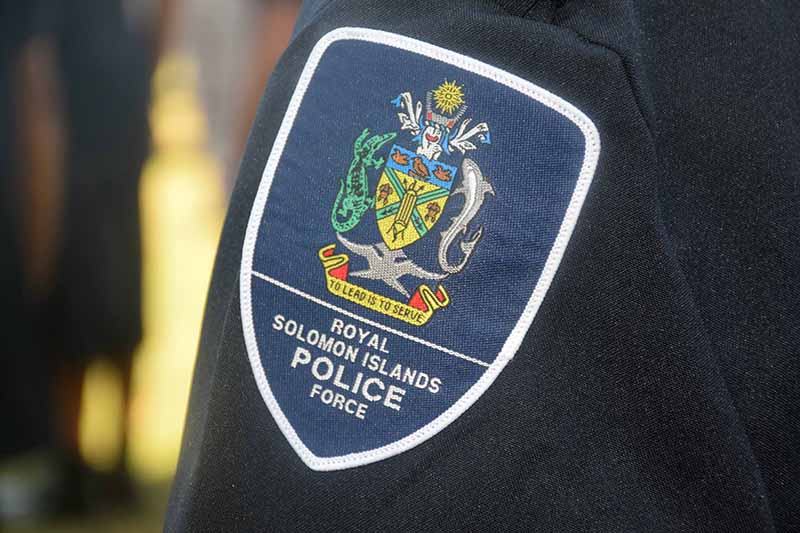
Picture © Royal Solomon Islands Police Force