

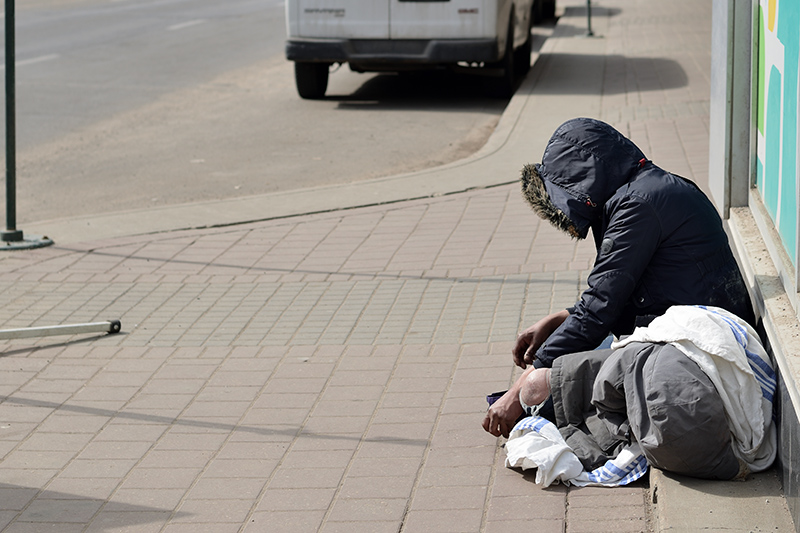
Our work with 81 unhoused and street-involved community members reveals how big-city drug traffickers moving into smaller Canadian communities can wreak havoc.
Public concerns about fentanyl’s proliferation across Canada have focused on overdose deaths and drug-related disorders. However, in addition to these pressing concerns, our recent research in Thunder Bay, Ontario, unmasks additional impacts of Canada’s street-based drug economy.
Our work with 81 unhoused and street-involved community members reveals how big-city drug traffickers moving into smaller Canadian communities can wreak havoc. These out-of-town dealers often forcefully take over people’s homes so they can use them as a base to sell and produce drugs.
These groups and their home takeovers are a significant contributor to homelessness. Home takeovers force people out of housing and into homelessness, deepening cycles of poverty, housing instability and trauma.
Drug traffickers move in
In recent years, drug trafficking groups have distributed and manufactured fentanyl within and beyond Canada. Canada’s major urban centres, like Toronto and Edmonton, are now saturated with various criminal groups competing for a share of profits from the illicit drug trade.
Consequently, some groups have figured out that expanding or exporting their operations into smaller Canadian communities like Thunder Bay can be immensely profitable.
Smaller cities often bring less competition, significantly drive up drug prices and provide these newly arrived dealers with greater anonymity from law enforcement.
Entrepreneurial groups have adapted the long-standing practice of deploying home takeovers within drug economies. This works for their market expansion efforts.
Drug traffickers’ movements into smaller cities have raised serious public safety concerns, increasing local residents’ exposure to gun and drug-related violence.
Organized drug trafficking networks have significant resources but even so, moving into a new community to set up shop within the criminal underworld is no easy task.
One reason is that smaller communities often have some established players in the informal drug economy who may not be willing to step aside or share their client base with the newly arrived urban dealers.
That means entrepreneurial groups have adapted the long-standing practice of deploying home takeovers within drug economies. This works for their market expansion efforts.
‘Trap houses’
In a home takeover, out-of-town drug traffickers prey on low-income residents in social housing units and those who are otherwise marginalized. They forcefully take over their residence, and convert them into ‘trap houses’.
In other words, people’s residences become the base from which these groups produce and sell drugs and operate their business. These trap houses shield the drug traffickers from police and other authorities by reducing their need to sell drugs in public spaces.
Our research participants reported that out-of-town drug traffickers use a range of violent, coercive and manipulative tactics to gain initial access to their homes, including providing free drugs, forcing drug repayments, violence and extortion.
Residents often have no choice but to accept these groups into their residence. Our research participants reported that out-of-town drug traffickers use a range of violent, coercive and manipulative tactics to gain initial access to their homes, including providing free drugs, forcing drug repayments, violence and extortion.
As one of our participants said, resisting a home takeover is almost impossible because drug traffickers can always find a way into their homes and will retaliate if they can’t get in: “They find their way in. There’s always a way in, and there’s always a weak point.”
Drug traffickers often prey on seniors or newly housed individuals, often within days or weeks of them moving in: “When a homeless person gets pulled off the street, and they get given [a housing unit]… [the drug traffickers] reach out anywhere between six and eight weeks, and then it becomes a trap [house].”
Homelessness and housing insecurity
Residents whose homes have been taken over are left with little to no recourse. Reporting takeovers to police or housing authorities is rarely an option. Many residents fear eviction, criminal charges or that dealers will retaliate with violence toward them or their family and friends.
As one participant put it: “If you call the cops, you’re probably dead.” Given these fears, they see abandoning their home as the only way to escape this dire situation.
By not reporting to their housing authority or police, their homelessness and need for new housing remain undocumented. Critically, many former residents are often precluded from joining other housing support waiting lists.
Even after moving and somehow managing to get a new residence, several of our participants became homeless once again after their new place was also taken over.
Risk for homelessness
Police also play a critical role. They must treat residents experiencing home takeovers as victims, not as suspects, and build trust with the victimized individuals assuring them that they can be protected from retaliation if they speak up.
Home takeovers should be treated as a serious risk factor for homelessness. Social housing providers can help by creating pathways for residents to report these takeovers safely, protecting them from legal consequences, and by moving people quickly into a new residence if needed, without penalizing them.
Police also play a critical role. They must treat residents experiencing home takeovers as victims, not as suspects, and build trust with the victimized individuals assuring them that they can be protected from retaliation if they speak up.
Addressing home takeovers is not only about limiting drug trafficking – it is also about protecting people’s homes, reducing homelessness and strengthening community safety.
This article first appeared on The Conversation, and is republished under a Creative Commons Licence; you can read the original here
About the Authors
 Dr Marta-Marika Urbanik is an Associate Professor in the Department of Sociology, at the University of Alberta. She is an urban ethnographer, specializing in gangs, neighbourhood redevelopment, and inner-city policing in the Canadian context. Her research interests include issues pertaining to harm reduction, neighbourhood violence, gangs, neighbourhood revitalization, and police-community relations (including police misconduct). Marta-Marika completed her PhD in the Department of Sociology, with a specialization in criminology at the University of Alberta. Her doctoral research analyzed the effects of neighbourhood revitalization on gangs, criminal structures, and violence within Canada’s oldest and largest social housing project (Regent Park).
 Dr Carolyn Greene is Assistant Professor of Public Safety at Wilfrid Laurier University, and received her PhD in Criminology from the University of Toronto’s Centre for Criminology and Sociolegal Studies. She began teaching at the University of Toronto, and spent 16 years as an Assistant Professor in the Criminal Justice Program at Athabasca University, before joining Wilfrid Laurier University in 2022. Throughout her career Dr Greene has taught a range of undergraduate and graduate courses, including research methods in public safety, public safety in Canada, theories in corrections, policing, ethics, youth justice, victims of crime, and the psychology of criminal behaviour.
 Dr Katharina Maier is an Associate Professor of Criminal Justice at the University of Winnipeg, and holds a Law Degree from the University of Münster and a Master’s degree and PhD from the Centre for Criminology & Sociolegal Studies at the University of Toronto. As a qualitative researcher, she is interested in examining issues around punishment and penal governance, prisoner re-entry and penal supervision, policing, urban poverty and social marginality, and the work of front-line penal actors. Dr Maier is leading a two-year SSHRC funded project on policing, public health, and methamphetamine use in Winnipeg.
 Dr Matthew Valasik is an Associate Professor in the Department of Criminology and Criminal Justice at the University of Alabama. His primary research interests are the socio-spatial dynamics of gang behavior and problem-oriented policing strategies (eg, gang units, civil gang injunctions) used by law enforcement. His work has appeared in a range of academic publications including the Journal of Criminal Justice, Social Science Research, Homicide Studies, Theoretical Criminology, Crime Science, and the Journal of Criminological Research, his work has also received coverage in mainstream media outlets such as The Monkey Cage by The Washington Post, The Guardian, and The Crime Report.
Picture © EdmontonMartin / Shutterstock