
When Shawn Kneisel joined the police force in 2013 after nearly a decade in the U.S. Army, he took a look at the standard SWAT team helmet he was issued and decided to do some research of his own.
EPIC and RIFLETECH are built with Ceradyne’s patented Seamless Shell Technology, featuring no-thru holes design which ensures consistent performance and structural integrity across the entire shell; while EXFIL and EXFIL SL use a polyethylene and other fibers in a proprietary composite matrix shell technology.
“I went out and looked at what was available in the market and settled on the Team Wendy EXFIL,” he said. “I wasn’t interested in using the one from the 1990s that I was issued, so I used my own money and purchased the best option I could find.”
That EXFIL helmet still sits on Kneisel’s desk in his Team Wendy office in Cleveland, where it serves as a daily reminder of the individual law enforcement officer in the helmet – whose lives are dependent on the first-rate protection levels it delivers.
Today Kneisel is a Product Specialist for Team Wendy’s ballistic helmet product line, which covers EXFIL (still a leading product) along with EXFIL SL (Super Light), EPIC and RIFLETECH in the law enforcement segment.
Critical protection
EPIC and RIFLETECH are built with Ceradyne’s patented Seamless Shell Technology, featuring no-thru holes design which ensures consistent performance and structural integrity across the entire shell; while EXFIL and EXFIL SL use a polyethylene and other fibers in a proprietary composite matrix shell technology.
All feature the Team Wendy Air fit liner system with Zorbium® foam technology, and boltless CAM FIT™ retention system with BOA® dial for a secure, adjustable fit. This combination provides critical protection for the most likely head injury scenario in law enforcement.

Team Wendy helmets are designed with direct input from officers and feature U.S. DoD DNA—ensuring comfort, increasing survivability, and adaptability for every scenario.
“In the field it’s easy to be thinking always about that critical ballistic protection level, and obviously that is very important,” Kneisel said.
“But in my experience as a SWAT guy, you are much more likely to smash your head while exiting the armored vehicle on your call-out – these are the much lesser known threats law enforcement officers face while going about their day-to-day responsibilities.”
Traumatic brain injury (TBI)
Indeed, across modern policing, one operational truth is becoming increasingly difficult to ignore: traumatic brain injury (TBI) is far more prevalent among police officers than previously recognised.
Research shows that officers experience significantly higher rates of TBI than the general population, with blast exposure, blunt‑force trauma, vehicle collisions, and assaults all contributing to a growing and often invisible threat. And as policing environments become more complex, unpredictable and violent, the need for advanced, scientifically engineered head protection has never been more urgent.
Public‑order policing, forced entry, exposure to explosive devices, and even repeated low‑level impacts during routine duties all create conditions where sub‑concussive forces accumulate over time.
Yet many agencies still rely on testing standards that do not address the realities of today’s threat landscape. Traditional ballistic helmet standards do not adequately account for the complex forces that cause brain injury. This leaves a gap between real‑world risk and outdated testing methodology. This gap is precisely where Team Wendy distinguishes itself.
Drawing on decades of research into blast physics, brain biomechanics, and impact mitigation, Team Wendy has become a global leader in protective headgear. Its helmets are not simply ballistic shells; they are integrated protection systems designed to reduce the likelihood and severity of TBI.
Public‑order policing, forced entry, exposure to explosive devices, and even repeated low‑level impacts during routine duties all create conditions where sub‑concussive forces accumulate over time.
“For that reason, our design philosophy across the entire Team Wendy tactical helmet portfolio begins with this scientific truth: protecting the brain requires more than stopping a bullet,” Kneisel said.
Impact protection

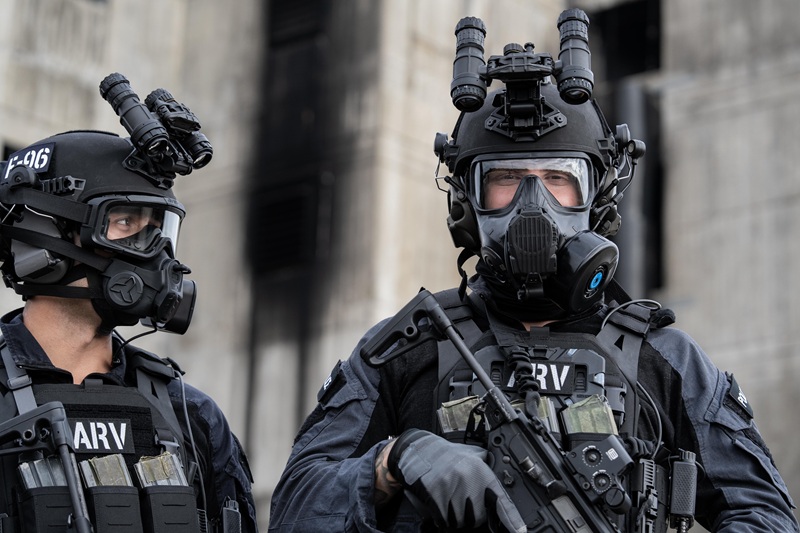
Team Wendy’s tactical helmets are engineered for ballistic resistance, integration with night vision and communication systems, and mission-specific adaptability—supporting operators with the highest levels of comfort in the most demanding scenarios.
Team Wendy’s work on impact protection is among the most advanced in the industry. Its research shows that mitigating TBI requires controlling the energy that reaches the skull and brain, not merely preventing penetration. This is achieved through a combination of proprietary materials, multi‑layered impact architecture, and optimised fit systems.
The company’s Zorbium foam liners are engineered to manage both high‑energy impacts and the low‑energy, repetitive forces most associated with long‑term neurological risk. Instead of relying on a single foam density, Team Wendy uses layered systems that respond differently to different types of forces. This is essential for police work, where threats range from thrown objects and baton strikes to vehicle collisions and explosive overpressure.
Fit is another critical factor, as a poorly fitted helmet can compromise protection. Team Wendy’s adjustable padding and retention systems ensure a secure, stable fit that reduces harmful movement. This means that Team Wendy helmets are engineered to reduce the likelihood of TBI across the full spectrum of policing threats, not just the ones covered by historical standards.
While impact mitigation is essential, ballistic performance does remain a core requirement for many police roles, and Team Wendy’s EXFIL, EPIC and RIFLETECH ballistic series helmets reflect the latest research into material science, fibre architecture, and energy dispersion.
Today’s law enforcement teams are wearing a lot more kit on their head than ever before, which has seen the helmet shift from a simple piece of head protection, towards more of a helmet-as-platform type approach
Shawn Kneisel, Product Specialist
Team Wendy
The company’s design approach for helmet shell construction is pioneering the use of ultra-high molecular weight polyethylene (UHMWPE) materials – as reflected in its newest RIFLETECH helmet, which is leading the market in providing NIJ III ballistic performance at weight of just ~3.0 lbs.
Helmet as a platform
“Today’s law enforcement teams are wearing a lot more kit on their head than ever before, which has seen the helmet shift from a simple piece of head protection, towards more of a helmet-as-platform type approach,” Kneisel explains.
“Depending on the mission, you are carrying attachments like NVGs, hearing protection, communications headsets, so helmets serve as an effective means to make you more operational and better able to do your job.”
Making the helmet itself as light as possible enables more kit to be mounted to the helmet, while delivering a comfortable, non-fatiguing experience for the wearer.
“UHMWPE materials are enabling RIFLETECH to do something that no other helmet out there can do: it’s offering that ballistic protection in a lightweight, comfortable package,” Kneisel said.

The RIFLETECH helmet from Team Wendy delivers elite-level ballistic protection and all-day comfort in a lightweight, mission-ready design.
“And with its Air Fit helmet liner you’ve got integrated air channels, excellent heat dissipation, cooling fabric, and strategically placed cooling pads which enhance breathability.”
Perhaps most critically, all of this comes together in a package that is going to be worn.
“The thing you run into as command staff is you see guys taking off their helmets,” Kneisel said. “If you’re in a SWAT stand-off and the offender doesn’t come out for 12 hours, you can’t decide at what point in that 12 hours he’s going to start shooting at you, so taking off your helmet because you’re hot and uncomfortable defeats the purpose.”
Ballistic rating
In terms of ballistic rating, RIFLETEC offers NIJ Level III protection, meaning it’s built to stop rifle rounds, including 7.62×39 MSC, 7.62x51mm FMJ, and 5.56 M193 BT—all at muzzle velocities.
That ‘muzzle velocity’ is an important qualifier when it comes to ‘rifle-rated’ helmets. The newest generation of ballistic helmets aim to protect against Level III/RF1-type rifle threats, such as 7.62 FMJ lead core. However, there is no industry-standard for the methods used to test and qualify these helmets for rifle protection. Some helmets are tested using lower-velocity rifle cartridges, reduced-load ammunition, or cartridges such as .300 Blackout. While these are technically rifle rounds, they operate at significantly lower velocities and energies than common military rifle threats. Others may claim rifle ratings but only test their helmets at lower velocities, often specifying a speed that is less than muzzle velocity.
Team Wendy differentiates itself with transparent testing data available so that potential users can understand exactly the threats against which it will provide protection in real-world scenarios.
“This means that while the helmet might stop a round under certain conditions, it requires the shooter to be at a distance where the bullet’s velocity has decreased,” Kneisel said. “In extreme terms, almost any helmet could be called “rifle-rated” if the bullet is slow enough due to distance.”
Here Team Wendy differentiates itself with transparent testing data available so that potential users can understand exactly the threats against which it will provide protection in real-world scenarios.
“By providing detailed calibre testing data, there is no misunderstanding what we are classifying as a rifle calibre,” Kneisel said. “RIFLETECH is evaluated for resistance to penetration at muzzle velocity, which is the fastest speed a round leaves the weapon, and is the critical measurement when testing rifle ratings.”
For this reason, RIFLETECH is designed for the realities of close-quarters encounters many law enforcement teams now face in the field.
While NIJ ratings focus on specific ballistic threats, V50 values help assess how well a helmet performs against fragmentation and high-velocity impacts and highlights the maximum lifesaving potential of a helmet.
V50 represents the velocity at which a projectile (such as shrapnel from explosives or secondary projectiles) has a 50% chance of penetrating the helmet shell, signifying the breaking point of armor.
A higher V50 indicates better performance against these high-speed fragments. For example, many helmets, including Team Wendy’s EPIC line, report V50 values exceeding 2,400 feet per second (731 m/s) when tested with 17-grain fragment-simulating projectiles. RIFLETECH, however, is tested to a V50 of over 4,430 feet per second (1,350 m/s). All in that ~3.0 lbs package.
Combined with its rifle-rating, this performance level ensures RIFLETECH maintains its ballistic integrity in real world conditions, making it the top choice for special operations and tactical teams facing rifle threats.
“We believe our helmets are not just protective equipment, they are an investment in officer safety, operational effectiveness, and long‑term health,” Kneisel said. “As policing evolves, so must the equipment that protects those who serve.
“With TBI risks rising and traditional helmet standards failing to capture the complexity of modern threats, agencies need head protection that is scientifically engineered, operationally flexible, and proven in the field – we strive to deliver exactly that.”
Team Wendy, part of the Avon Technologies PLC group of brands, provides exceptional head protection systems designed from the inside out for those who risk their lives every day. Founded in 1997, the Cleveland-based company places a strong focus on the prevention of traumatic brain injury (TBI) in honor of the company’s namesake, Wendy Moore, who died tragically from a TBI following a ski accident.
As a leading supplier of helmet systems for military, law enforcement, search and rescue, and adventure sports, Team Wendy is steadfast in its dedication to the pursuit of improving head protection research, design and development, bringing more choice, better technology and reliable customer service to the industry.
Visit the Team Wendy website to learn more about Team Wendy’s range of helmets for Law Enforcement.