

Investigative interviewing has the potential to unlock evidence that helps solve crimes and deliver justice, but it involves more than simply ‘asking questions’. To get comprehensive information, you need to know how to ask the right questions, in the right way.
Multiple studies over the past decade have conclusively demonstrated that avatar-based simulations, when paired with immediate, evidence-based process and outcome feedback, reliably improve questioning habits and support best-practice interviewing.
As an interviewer, that is under your control – if you understand what the ‘right’ questions are, and the best way to ask them.
Research into effective interviewing highlights the importance of asking open-ended questions to elicit comprehensive answers, and also demonstrates that people respond more openly in interviews when they experience rapport. Until recently, delivering training that teaches and embeds these investigative interviewing skills has often hit a wall of resource constraints, but the good news is that technology can now help.
Multiple studies over the past decade have conclusively demonstrated that avatar-based simulations, when paired with immediate, evidence-based process and outcome feedback, reliably improve questioning habits and support best-practice interviewing. These gains are proven to last for months and carry over to real investigations.
Investigations and training company OSACO Group have now combined this learning capability (incorporating the principles of the trusted PEACE method for conducting thorough interviews, and the ORBIT rapport-based interviewing model, developed by Prof. Laurence Alison and Emily Alison at the University of Liverpool), into one effective and accessible training solution – EchoMind.
By conducting interviews with an avatar in an online interview simulation, investigators and interviewers worldwide can access ongoing, cost-effective training at scale; receive feedback to help hone the interview techniques that research has proven to be most effective; and practice these techniques multiple times before they interview a real person.
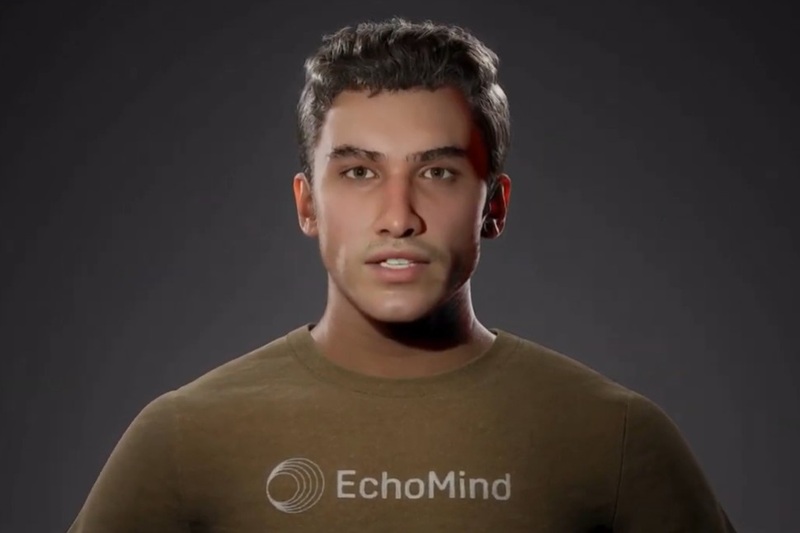
Ethan, the core avatar subject in EchoMind interview simulations, explains what EchoMind is and how it helps improve investigative interviewing technique.
The need for a new way of learning
Following good practice within police departments across the world, the PEACE model (Preparation and Planning; Engage and Explain; Account (Clarify and Challenge); Closure; and Evaluation) is an acknowledged method of effective interviewing. PEACE promotes the use of open-ended questions and techniques to build rapport and trust, both of which encourage open information sharing. Yet, while acknowledged as foundations for successful interviewing, these are not natural skillsets for everybody; they must be learned, evolved and continually practiced.
Traditional investigative interview training tends to rely on intensive bursts of learning via classrooms and role plays, providing interviewers with rapid enhancement in understanding and skill.
Traditional investigative interview training tends to rely on intensive bursts of learning via classrooms and role plays, providing interviewers with rapid enhancement in understanding and skill. However, such learning opportunities are limited in accessibility and repeatability so, without ongoing practice, does such learning become embedded as the default technique?
Evidence indicates that it doesn’t; interviewers default to bad habits.
Research into the effectiveness of investigative interviewing was initiated by Prof Pekka Santtila and his colleagues at Åbo Akademi University in Finland in 2015, and still continues under his guidance at New York University. This research initially focused on forensic interviewing of child sexual abuse (CSA) victims – although studies have showed similar results when applied to adult-witness interviews[i] – where the use of suggestive or closed-ended questions makes accurate recall difficult. However, both question types are still regularly employed by interviewers[ii] because, without ongoing practice and interviewer-specific feedback, it is difficult to create and maintain good interviewing habits[iii].
Interviewers typically defaulted to questions that could only be answered yes or no, offered a limited number of alternatives or were in other suggestive or closed-questioning styles. Such closed questioning has been proven to:
- hinder accurate recall,
- inflate false-positive reporting and
- undermine courtroom credibility.
AI delivery backed by human data
The good news is that AI provides us with a very effective enhancement to traditional training, and can support and extend classroom-based learning.
Prof Santtila’s studies considered training options that used avatars and incorporated feedback after each training session.
In short, participants more than doubled their use of open-ended questions.
The studies demonstrated that before training with avatars, participants (whether inexperienced or experienced interviewers) used about 35% open-ended questions; after one-hour of training with avatars (four interviews with feedback), this dramatically increased to 80%[iv].
In short, participants more than doubled their use of open-ended questions. This represents a robust improvement in questioning skills, significantly enhancing interview quality related to both use of recommended question type, and the reliability and accuracy of information received.
Research also proved that the combination of avatar-based simulations with feedback (essential in developing sustained effective interviewing skills[v]), enabled the successful transfer of skills – particularly when supported by monthly training ‘boosters’ – to real-world interview scenarios with both children and adults[vi].
A scalable, accessible and more cost-effective solution
This is the research that underpins EchoMind, and it is supported by the decades of real-world policing and investigations experience of OSACO’s founders Sean and Jaydene Buckley. Having experienced the limitations of traditional classroom-based, single-event training and seen the impact this has on underprepared interviewers, vulnerable interviewees and investigation outcomes, they immediately saw the potential of AI simulations to transform the investigative interview learning environment.
As an online learning solution, EchoMind therefore answers the challenge of scale.
Created using LLM technology, EchoMind’s sophisticated avatars respond verbally and emotionally as a real interviewee would, creating environments in which interviewers can practice essential rapport and trust-building skills. The technology supports development of multiple scenarios; compliant and non-compliant witness, victim and suspect avatars; and complexity that supports learning at all skill levels.
Post-session feedback enables interviewers to better understand the type of questions they most frequently use (effective open questions or response-limiting closed / directive / suggestive questions), as well as the accuracy or completeness of the information that their usual question style elicits. Online accessibility delivers access to short, easily repeatable training sessions; by practicing for 10 minutes six times a month, trainees can prevent the skill fade that occurs with intensive, one-off training.
As an online learning solution, EchoMind therefore answers the challenge of scale: it offers continuous and progressive training for thousands of officers who can practice their interviewing from basic to complex scenarios, without absence from or interruption to their core duties.
Building the ‘how’ into better technique
EchoMind never forgets that it is designed to enhance interactions between people, and it now incorporates the principles of ORBIT, which complement the steps outlined in the PEACE methodology.
This partnership offers maximum benefit to investigative interviewers, wrapping ORBIT’s principles of the ‘how to’ of rapport-building into EchoMind’s ability to offer accessible, repeatable and scalable training.
PEACE outlines the essential phases which form the foundations of effective, ethical interviews and evidence gathering, and it advises rapport-building; but it does not tell you how to build rapport. The ORBIT model – Observing Rapport Based Interpersonal Techniques – does, ensuring interviewers will be better qualified in building the rapport that is so essential to solicit quality information.
Prof. Laurence Alison and Emily Alison’s work in forensic psychology and research into rapport-based interviewing at the University of Liverpool led to the creation of ORBIT, which has helped develop proficient investigators and interviewers across the law enforcement, military, intelligence and corporate sectors.
ORBIT has been based on a globally unique dataset and coding from thousands of hours of real-world interviews. This data has been used to develop a comprehensive interviewing model that focusses on how to build rapport, and it has been proven to produce more accurate accounts.
“ORBIT is broadly sympathetic and congruent with what is taught in PEACE” says Prof. Alison. “It is about enabling police officers (or other interviewers) to understand the skills that are required to deal with people when they are being resistant or difficult and encourage them to interact and engage.”
ORBIT outlines a methodology for engaging that is built on trust, honesty and empathy by focussing on:
- Rapport and Engagement – Using the HEEAAR principles to increase information yield
- Managing difficult behaviour – Understanding the “Interpersonal Wheel” to navigate resistance without confrontation; and
- Challenge without confrontation – Knowing when to challenge and when to listen.
Understanding and mastering these skills increases the chance of successful interviews, especially when interviewing resistant subjects, or victims or survivors of sexual misconduct or assault. Building rapport through empathy, respect, and patience is essential to create a safe environment that supports trust and encourages accurate, meaningful disclosure, and reduces the risk of re-traumatisation.
“The model’s the same (in any country/culture)” says Prof. Alison. “Honesty, empathy, autonomy, evocation, interest in values, thoughts, beliefs. The forms of resistance or difficulty might be different – embarrassment, shame and fear. But if you speak to people appropriately, if you are persistent, you are patient, you’re able to be versatile, you’re authentic, you’re interested, you’re listening, you get more information.”
Law enforcement personnel across the world already utilise ORBIT with demonstrable results, increasing investigative yield and engagement, and reducing resistance in interview settings. ORBIT has been used to train thousands of officers worldwide from the FBI, CIA, UK Police, Military, Border Force and many other military and law enforcement agencies across Europe, North America and parts of Asia and Africa.
This partnership offers maximum benefit to investigative interviewers, wrapping ORBIT’s principles of the ‘how to’ of rapport-building into EchoMind’s ability to offer accessible, repeatable and scalable training.
Forever evolving
Like all technology, EchoMind is already rapidly evolving. Stage One victim and suspect avatars will be available within the platform in early 2026, and subsequent iterations will come online during the year. Whilst additional standard scenarios are being added to the EchoMind training library, including both criminal and workplace/HR-related options, a scenario-builder will soon enable clients to create bespoke scenarios, specific to their own environments or issues.
Yet whatever the scenario or whoever the interviewee, the essential skills for effective investigative interviewing remain the same – open-ended questions and rapport-based approaches deliver better information. By incorporating the PEACE model of interviewing planning alongside the ORBIT model of engagement and interaction, EchoMind offers a best practice learning solution that is available anywhere, anytime.
EchoMind is available for organisational subscription and also individual subscriptions.
 Enquiries about ECHOMIND can be directed to OSACO Group Global Director of Operations Sean Buckley, or visit OSACO Group’s website or direct link: https://www.osacogroup.com/echomind-ai-interview-training/
[i] Tohvelmann et al., in press.
[ii] Cederborg et al., 2000; Sternberg et al., 2001.
[iii] Lamb et al., 2002.
[iv] Research conducted by Professor Pekka Santtila and his team at New York University.
[v] Pompedda et al., 2022.
[vi] Kask et al., 2022.