


As society’s digital transformation continues at pace, the possibilities for policing to access a huge wealth of data to achieve its aims of preventing crime, investigating and arresting offenders, and supporting victims have never been greater.
The big question now is what to do with all that data? It’s a challenge that John Kilburn, who served with Queensland Police Service for 27 years and is now Law Enforcement Industry lead at data and artificial intelligence (AI) specialist SAS, knows only too well.
Data is coming in from everywhere, from driver’s licence systems, the courts, number plate recognition systems, voting electoral rolls, intel systems… The key is being able to analyse all that data to give you a productive, actionable output, and that’s where data analytics comes in.”
John Kilburn, SAS
“The real killer for policing is what I call the ‘three Vs’ – the volume, velocity and variety of data,” explained John.
“Data is coming in from everywhere, from driver’s licence systems, the courts, number plate recognition systems, voting electoral rolls, intel systems… there are all these different data sources, and it’s coming in faster than ever. The key is being able to analyse all that data to give you a productive, actionable output, and that’s where data analytics comes in.”
While many officers and staff will already be aware of the benefits that data analytics and the use of AI can bring to complex investigations, “actionable outputs” can take many forms.
“I’m an investigator – my background is investigations, particularly in counter-terrorism and security intelligence – so I know how much difference this new technology can make in investigating crime,” continued John.
“But data analytics and AI can give you the evidence to make really, really smart decisions, in multiple areas of policing. That can be about resourcing, about the equipment your officers need, and about where you send your officers and why.
“Having an understanding in real time, or near real time, about what is occurring inside a police division, district, region or total jurisdiction – such as the type of offences, the demographics of victims, and demographics of offenders – is invaluable.
“It means your decisions are evidence-based, not just a gut feel or a response to a public perception or a media report.
“A good AI-driven analytics platform will give police on the street better situational awareness and a better understanding of what’s going on in their local geography; at the same time, a commissioner or chief of police can have a strategic outlook based upon the same data.”
Data – an officer’s new essential gear
Delivering those operational advantages is one of the main policing benefits of data analytics and AI, but again, is does come with challenges. John’s view is that rather than being the sole preserve of back room specialists and tech experts, data is very much another tool for officers on the front line.
“The data is another accoutrement on their accoutrement belt. We talk about guns, about batons, Tasers, and body-worn cameras, but data is as powerful, if not more so, than all of those accoutrements in assisting officers to get their job done. The problem is that we have to be able to convince frontline police that data is a thing.”
Those benefits, however, are not just felt within policing operations. The speed, accuracy and consistency that AI-driven data analytics can bring means quicker and more effective public safety and justice for communities: “It means commanders can make decisions that save lives, that can prevent crime, that give them strategic oversight,” said John.
CASE STUDY: SAS enables AI-powered investigations for the Australian Federal Police
Working with SAS, the Australian Federal Police (AFP) implemented a modern investigations management solution, which officers can use to document investigations and manage operational information and intelligence.
Designed for strategic and long-term cases, as well as for in-depth investigations, it aligns with AFP-specific investigative doctrines, investigation standards and practices. Going forward, it will enable AFP investigators to manage their investigations on a single platform, from receipt of a report or request through generation of a brief of evidence and the finalisation of the investigation process.
Enhanced productivity and more effective use of resources can also improve the public perception of policing: “The public expectations are that they want to see their protectors, they want to see their community safety officers, and they want to see them using the latest and greatest technology to improve public safety.”
And the same technology, sometimes viewed with suspicion by sections of the public concerned that computers will be making all the decisions, can actually increase confidence if used ethically and transparently.
There is already a mindset in some quarters that that AI is dangerous – ‘We don’t want it to make decisions’ – so it’s imperative to articulate properly that this is not going to make decisions for you.”
John Kilburn, SAS
“I think the biggest concern, for both police and public, is around the ethical governance and use of AI,” explained John. “There is already a mindset in some quarters that that AI is dangerous – ‘We don’t want it to make decisions’ – so it’s imperative to articulate properly that this is not going to make decisions for you.
“It’s still about police officers, investigators, commanders, all the tactical operators, making decisions. We’re just helping them get all of the facts that they need to make that decision at the right place, at the right time, so that they’ve got confidence in what they have in front of them.
“But it’s not Robocop – you will not have a robot execute laws and conduct these investigations, it’s not going to happen.”
Three key success factors: platform, process, and people
So what are the challenges for forces around identifying and adopting the right AI and data analytics package? As always, budgetary constraints play their part: “Forces usually have restricted or limited budgets, and it can be hard for suppliers to quantify what the value proposition looks like for them,” said John.
“You’re also competing; if you’ve got police officers who need physical accoutrements like new slash vests, new ballistic armour, new body-worn cameras, new vehicles, new riot shields, all those things, then you’re competing for that one bucket of money.”
In many instances police forces have also had their fingers burnt in previous forays into new technology, and when considering AI projects are looking for an incremental approach, so they can start small and build bigger.
“For me,” said John, “the success of introducing AI and data analytics is about three things – platform, processes and people. There has to be an understanding that you need the right end-to-end platform that can take all the data and help you be able to do something with it. So it’s consistent language across the whole agency.
“You need to make sure that the system is configurable enough to meet your force needs, and helps you streamline the processes you already have to enable you to do better as you build that system.
“And lastly, and perhaps most importantly, people. Agencies need to train their people. They need their people to understand what they can do with the data, how they can manage it, how they can best utilise it to help them make decisions. If they don’t invest in their people, then it all kind of falls over.”
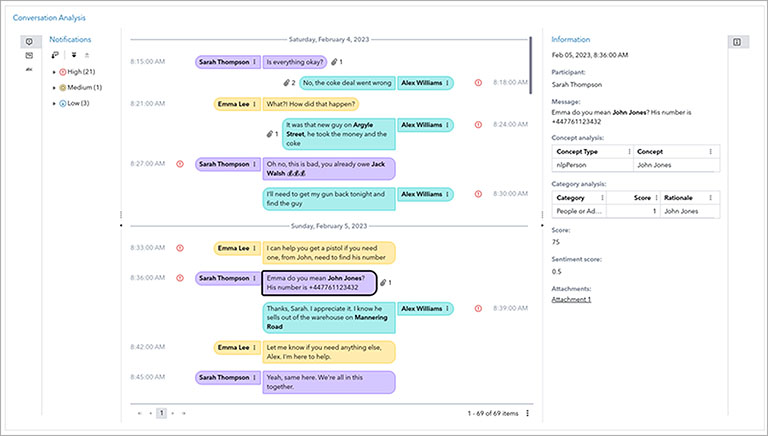
Data analytics can enable you to explore and analyse conversational exchanges between multiple parties, for example chat logs or interview transcripts assisting investigators to identify actionable intelligence and maximize investigative opportunities. This allows agencies to tackle the volume and complexity of data they encounter while empowering investigators to unlock hidden insights.
A step-by-step and transparent strategy
A recent SAS white paper emphasizes the importance of understanding analytics culture in order to find the right technology, how to educate internal teams and stakeholders, and the need to engage with the community.
But the ‘start small and build bigger’ approach fits well with the SAS ethos: “We don’t come in and just turn all the lights off on one system and move to the other,” said John.
It’s got to be ethical, it’s got to be transparent, and you have to have confidence in where your data has come from, how it’s being managed, how it’s being crunched inside from an analytics perspective.”
John Kilburn, SAS
“You may have a vast array of data sources – RMS, CAD data from your call centres, an intel system, body-worn camera footage, phone downloads – all in different places. We take all those data sources, feed them into our enterprise system, and help you to construct models on the other side, that helps you to do your business.
“We’re not looking to replace the specialists who, for example, extract data from phones or run ANPR; we take all of that data and put it into a system that allows you to view it all in its totality, rather than just looking at one bit.
“But importantly, we take the raw data – prior to any AI application – because we know that if there is an AI component associated with it, the reporting and governance must be beyond reproach. It’s got to be ethical, it’s got to be transparent, and you have to have confidence in where your data has come from, how it’s being managed, how it’s being crunched inside from an analytics perspective.
“And if AI is being applied to help you make a decision, it’s clearly articulated what has been done and where. If I was the arresting officer, I would need to be able to explain the AI that was used and why, and then be transparent about that.
“That approach comes about in part because of our time in doing this, our history as a company, but also because we’ve been there, we’ve walked in those shoes, and we know what’s needed.”
The future of AI and data analytics
It’s clear that AI-driven data analytics already offers huge potential for forces around improving public safety and criminal justice outcomes, delivering greater efficiency and productivity, and increasing public trust and confidence in policing.
But with technology advancing at a rapid pace, John is also well aware of the potential developments over the coming years. “There are areas that haven’t reached anywhere near their full potential yet. For example, computer vision and surveillance systems are already widely used and effective, but the use of AI to monitor and analyse footage and identify movements, similarities and trends offers huge possibilities.
“The ability for a call-taker to take an anonymous call, have a voice to text system on the screen in front of them, prompt them for questions, and then use a specialised large language model to analyse that text and identify risks and intelligence is another area that is already in development.
“But as I said before, the most important point in AI and data analytics is that we’re not talking about automated decisions; it’s about positioning you to make the most intelligent decision that you can make as a human.”
Policing in the Age of AI: International Insights webinar – View the session recording!
This webinar highlights real-world examples of innovation in action — from using data to detect emerging crime patterns to designing ethical, transparent AI systems to assist in investigations. Gain actionable insights into what’s working, what’s evolving, and how agencies are navigating change.

SAS – from data to trusted decisions
SAS is a global leader in data and AI, bringing software and industry-specific solutions alongside decades of law enforcement experience to its work with more than 1,600 public sector agencies in 134 countries. SAS helps policing organisations to transform data into trusted decisions — from using data to detect emerging crime patterns to designing ethical, transparent AI systems that assist in investigations and crime prevention.
To learn more about how SAS supports the public sector, visit Click Here.